




News
New Talent Concerns Emerge as Tariffs, AI Roil Workforces and Top Brass


Article Written By: Frederic Lee
Boards should seek rigorous data on employee engagement, one source said
The Great Resignation is over, but that doesn't mean compensation committees can relax when it comes to human capital oversight, given the list of economic stressors flowing out of Washington impacting corporate workforces.
Namely, the frequently shifting trade policy carried out by President Donald Trump has disrupted global markets and impacted worker sentiment, sources told Agenda. At the same time, technological developments like artificial intelligence are roiling workforces as well.
Directors — especially those on the compensation committee — should maintain focus on worker attrition and engagement figures as hiring is expected to expand this year and the talent market gets tighter, increasing the costs of talent and potentially leading some workers to stay at companies where they're disengaged.
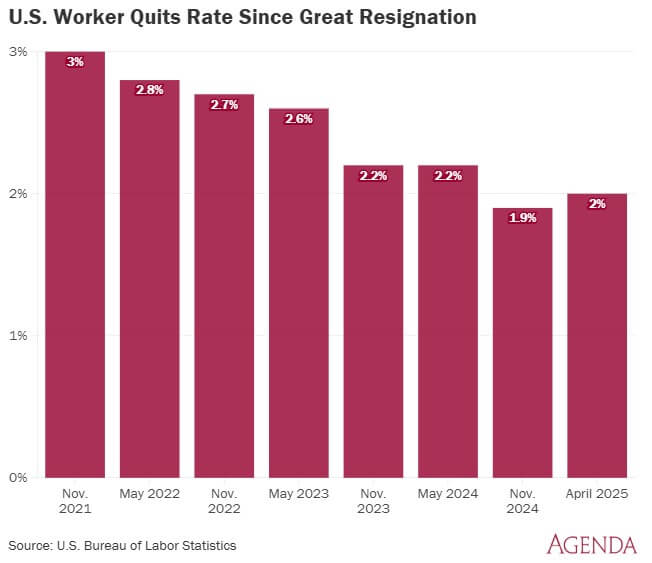
In April 2025, the U.S. quits rate hit 2%, and in the previous month, companies reported a quits rate of 2.1%, according to the most recent data from the U.S. Bureau of Labor Statistics. In February, the number of quits was 3.2 million, down by 273,000 versus 2024, according to the bureau. For comparison, the quits rate hit 3% in late 2021, during the height of the Great Resignation, when millions of workers voluntarily left their jobs in the aftermath of the pandemic. Further, the number of job openings was 7.2 million in March — down by 901,000 versus March 2024 numbers, according to the bureau.
Economic uncertainty is tamping down voluntary turnover in certain industries in part because employees don't want to relocate into a new position and then be the last hired, first fired, said Amy Cappellanti-Wolf, executive vice president and chief people officer at Dayforce, a global human capital management platform.
Therefore, boards should be diligent about analyzing human capital metrics from management regarding attrition and employee engagement to ensure there isn't a group of employees simply sticking around at the company until they feel comfortable leaving, she said.
If there is such a group, boards should encourage management to turn to reengagement, said Cappellanti-Wolf. She previously served on the board of directors at Softchoice, an IT solutions and managed service provider, where she was the comp committee chair, and Betterworks, a performance management platform.
A good deal of recent developments stemming from the Trump administration and other current events are shaping directors' concerns right now, particularly on trade policy, labor laws and matters related to environmental, social and governance issues, as well as diversity, equity and inclusion, Cappellanti-Wolf told Agenda. "Those [matters] are really under question right now," she said.
Amid the tumult, management teams should be producing rigorous analytics for directors on turnover, as well as employee sentiment and performance levels, so that boards can ensure they're not losing valuable people, said Cappellanti-Wolf.
Meanwhile, U.S. hiring is expected to accelerate this year, with more companies planning to expand their teams in the first half of 2025 compared with 2024 figures, according to information from Robert Half, a staffing, recruitment and job search firm. "This demand for skilled talent at a time of low unemployment and increasing job openings suggests that recruiting could become more competitive than it already is," according to the firm.
Further, the staffing firm conducted a recent survey of more than 2,000 U.S. workers that found that only 29% of professionals plan to look for a new job in the first six months of the year, down from 35% in July 2024.
Even though the hiring outlook for the full year was positive in the Robert Half survey, job cuts are up by 80% for the first five months of the year compared to the same period in 2024, according to Challenger, Gray and Christmas, suggesting uncertainty across the talent market.
Broadly, two major market factors are impacting the workforce these days: AI and tariffs — the latter of which comes along with broader market uncertainty and fears of a potential recession, said Reynaldo Ramirez, co-founder of Thrive HR Consulting.
Directors should seek to understand the consequences of these disruptive forces as they plan out their companies' strategy under three to four different scenarios, said Cappellanti-Wolf.
Boards should also avoid making quick decisions that may not be best for the company's long-term goals, especially since tariff policy is unsettled, said Cappellanti-Wolf. Meanwhile, she also urged corporate boards to pay close attention to the sways of the Trump administration.
Top Talent
Meanwhile, as rank-and-file workers shift their behaviors amid geopolitical and market uncertainty, compensation planning for top-level talent has also been impacted by trade policy. One potential fix for tariff ramifications on executive pay is the increased use of relative metrics, but that option isn't popular with everyone.
Amid various methods of addressing potential impacts from tariffs on executive compensation, Ben Burney, principal at Exequity, told Agenda that he'd be hesitant to recommend a heavy use of relative financial performance measures as a brace against negative tariff impacts.
It can be difficult to make true apples-to-apples comparisons of one company's performance versus another's, he explained. Instead, Burney vouched for widened performance ranges for CEOs and other executives.
"If you are going to use relative financial performance, you need to be very careful that you are taking a very close look at those companies you're comparing to, because you could end up in a situation where you are stacking the deck for yourself, or you're stacking the deck against yourself," said Burney.
Among relative metrics, he said, relative total shareholder return is probably the only one that most comp committees should consider, calling it "defensible."
For more information on this topic, contact Thrive HR at (408) 799-1425 or www.thrivehrconsulting.com