




News
Crypto Compensation: Core Knowledge for Attracting and Retaining Today’s Top Workers
Rey Ramirez and Jason Walker*

Cryptocurrency has been in the headlines frequently in the last half-year . . . and not for only good things. The prices of popular cryptocurrencies plummeted throughout 2022, and some cryptocurrency companies and their founders are facing bankruptcy and even the threat of imprisonment. Yet crypto has been volatile since its beginning, and volatility and uncertainty are not endemic to cryptocurrency. To ignore it exists may be the wrong strategy for companies attempting to attract certain hires, and mutual benefits to both employer and the appropriate employee are still possible. This article does not discuss the problems, but the potential opportunities that lie ahead.
Introduction: Businesses Need Better Talent Tools
In January 2022, a NYDIG report revealed that 63% of over 2,500 surveyed U.S. consumers with full-time employment were moderately to extremely concerned about inflation—and for good reason. Year-over-year inflation for that month was at 7.48%, a level unseen since 1982. The report described the labor market as “tighter than it has been since the 1950s.” And perhaps most shocking to many readers, the survey showed that up to 36% of respondents (depending on age cohort) are interested in getting paid a portion of their salary in Bitcoin.
These three factors — inflation, tight labor, and Bitcoin
Payment—may seem unrelated, but in fact they tightly interweave. As Morgan Stanley details, today’s “tight” labor market is characterized by companies being unable to fill their job openings for a range of reasons. At the same time, generationally high inflation means that those with (and seeking) jobs are seeing their dollars lose purchasing power at an alarming rate. At the 8.26% inflation rate prevailing as of this writing, every dollar held will have lost half its value in nine years. (Said differently, it will take $20 in 2031 to buy a burger that costs $10 in 2022.) Imagine getting paid in ice cubes and having no access to a freezer. Inflation is the ambient temperature melting every dollar’s value.
Bitcoin, and “cryptocurrency” more broadly, forms a corner
*REY RAMIREZ and JASON WALKER are co-founders of Thrive HR Consulting, a Silicon Valley, Austin, Texas, and Denver, Colorado-based HR advisory firm that seeks to augment HR needs for organizations, providing fractional HR services for leading, managing, or providing guidance in all facets of HR. Thrive HR provides a unique model that is helpful for companies that do not need full-time support but need expertise and guidance in the areas of executive coaching, mergers and acquisitions, employee relations, diversity inclusion and belonging, compliance, payroll, global HR expertise, talent acquisition, and digital workforce transformation
This paper was produced by Thrive HR in collaboration with William Van Winkle (williamvw@enwritenment.com)
Crypto Compensation: Core Knowledge for Attracting and Retaining Today’s Top Workers
of this triangle because it is not subject to conventional monetary inflation. As workers grow more informed about these economic principles and technologies, they see the wisdom of diversifying their stored value, especially into forms proof against broad monetary debasement. That is where the above 36% “interested” group comes from. Those consumers “get it,” and they are looking for employers that share and encourage their understanding.
This paper is for either of two types of HR and/or executive reader: (1) those who are curious about “crypto” and are looking for new tools to hire and retain talent, and (2) those who have reservations or outright negative feelings around crypto but are open to expanding their knowledge on the subject. In both cases, this paper will provide knowledge, context, and insight that businesses can use to bolster their talent efforts and positively differentiate themselves in a highly challenging labor market.
“There’s a huge brand and culture appeal by companies showing that they are engaged in the crypto space versus companies that are not,” says Patrick Sells, chief innovation officer at NYDIG. “One in five workers would leave their current employer for the same job at a different company that offered crypto benefits.”
As we will explore, there are many reasons to embrace crypto for talent compensation as well as some potential pitfalls to avoid along the way. While we will offer some advice, our purpose here is not to be prescriptive. Understanding what to do is the last concern. Understanding why crypto matters to employees and long-term business strategy is far more foundational, and so that is where we’ll dive in.
Key Concepts in Bitcoin and “crypto”
In most emerging technologies, new terms and concepts tend to get conflated, misunderstood, and misapplied by mainstream observers. The crypto space is no exception. Thus, it makes sense to start with a few key concepts and make sure we are having this discussion in the same language.
Blockchain
We all understand the concept of a ledger, which is simply a collection of account transactions. Similarly, a database is a collection of structured information. A blockchain is a ledger or database distributed across network nodes.
There are two key, related ideas to parse here: blocks and distribution. Imagine you have an application generating data. (One example could be cryptocurrency transactions, but others could be game avatars, real estate deeds, artist royalty contracts, or healthcare records.) That data needs to be stored somehow. A “block” is a cryptographically secured holding structure for data.
When an application generates new data, it gets distributed to nodes on the network. Obviously, the more nodes exist and the more distributed those nodes are globally, the better. A network with 30 nodes will obviously be far less robust, secure, and decentralized than a network with 30,000 nodes. Each network node solves mathematical problems to validate the data’s authenticity. When the data is validated, it gets written into a block. Blocks are periodically closed and locked in such a way that the data within them can be read but not manipulated. Because blocks finalize on a set schedule, they exist on a sort of ongoing timeline as a chain of blocks—a blockchain—that can function as its own sort of globally verifiable clock.
Consensus Mechanisms
One of the critical parts of this process is achieving network consensus, wherein the nodes agree on which transactions or data are valid. There are many means of achieving consensus, but the two most prominent today are proof of work (PoW) and proof of stake (PoS).
The PoW consensus mechanism that dominates in the crypto field today was first devised and implemented by pseudonymous Bitcoin inventor Satoshi Nakamoto in 2008’s famous Bitcoin white paper. Essentially, PoW “miners” each vie to see whose systems can be the first to arrive at a 64- digit hash value, something akin to solving a giant mathematical puzzle, and whomever wins gets to create the next block, confirm its transactions, and receive a “block reward” (a certain amount of Bitcoin, in this case). Nakamoto’s white paper describes PoW as “essentially one-CPU-one-vote. The majority decision is represented by the longest chain, which has the greatest proof of work effort invested in it.” A key point to know about PoW is that consensus (and thus network security) depends on processors consuming energy to perform the computation required to continue the blockchain.
The PoS consensus mechanism replaces energy-intensive computation with the ability to “stake” a given amount of the blockchain’s native currency (most notably ether (ETH) for the Ethereum blockchain) into a node account or pool of accounts. Basically, those who hold the currency can “buy” what amounts to a raffle ticket. The ticket selection process is randomized, and the winner gets to validate the current block’s data. The more one stakes, the more tickets can be had. That may sound dodgy, but it is not so different from PoW miners stuffing their mining facilities with thousands of optimized mining rigs, which drove most small, home-based miners out of the market. Instead of receiving block rewards, PoS miners earn transaction fees
Cryptocurrencies
A cryptocurrency—commonly and collectively abbreviated to “crypto,” although that can also refer to the entire field of cryptocurrencies—is any digital currency that relies on cryptography to secure transactions. The two blockchain networks mentioned above, Bitcoin and Ethereum, each have their own cryptocurrencies, Bitcoin (BTC) and ETH, respectively. In 2022, there were over 19,000 different cryptocurrencies. Many of these are “forks” (modified versions of prior code bases) of existing projects. For example, Litecoin is a fork of Bitcoin, and Dogecoin is a fork of Litecoin.
It is possible to create a new cryptocurrency in mere minutes, and most cryptocurrencies might be generously considered as extraneous. Within the top few hundred, though, there are many that serve a fascinating range of use cases, both current and experimental. Time will tell which survive and grow to play a major role in the coming decades.
Stablecoins
A stablecoin is a cryptocurrency with a value pegged to another asset. Often, that asset is the U.S. dollar. For example, the USDC and Tether stablecoins were created and are now managed by Circle and Tethe r Limited, respectively. Each company holds a reserve of assets, often U.S. dollars and similar equivalents, to serve as backing for issued cryptocurrency tokens. In other words, just as each dollar used to be backed by a known quantity of gold, each USDC coin is backed (generally) by one dollar. We call such coins asset-backed or reserve-backed stablecoins, and their market price is almost always $1.00, give or take fleeting fluctuations. Other options in this space are to have coins backed by a basket of fiat currencies, various commodities, or even other cryptocurrencies.
Alternatively, algorithmic stablecoins typically operate more like a fiat central bank, without 1:1 backing from underlying hard assets. Instead, they use a dynamic system of minting and “burning” to maintain a desired peg value (again, usually $1 per coin).
Central Bank Digital Currencies (CBDCs)
For most people, cryptocurrencies remain an unknown. Bitcoin is less than 15 years old, and it is the oldest player on the field. In contrast, the U.S. dollar has been with us practically since the country’s inception (although the rules by which that currency operates have changed multiple times). The dollar enjoys widespread trust and ubiquitous use, both as physical cash and in digital form through secondary facilitator networks. This begs an obvious question: Is not there some way to let the trusted dollar enjoy the benefits of a cryptocurrency?
The issue has been under discussion since at least 2014 and on the Federal Reserve’s radar by early 2015. The Bank of England and China were well into studying central bank digital currencies by 2016, and Yale produced a paper describing a “Fedcoin” solution for the U.S. soon after. China’s CBDC, the digital yuan (or digital renminbi), remains in testing as of this writing, but its primary wallet app, e-CNY, had 261 million unique users at the end of 2021.
CBDCs use distributed ledger technology, but that should not imply the ledger is decentralized or resistant to censorship. Financial censorship is when a government directly or indirectly blocks financial activity to one or more people or organizations because of those parties’ activities or affiliations. The Electronic Frontier Foundation has a page on this, and the early 2022 blocking of funds to the Canadian truckers’ “Freedom Convoy” offers a recent example undertaken by a major world government. CBDCs could make financial censorship easier for governments to enforce.
On the other hand, CBDCs offer several potential benefits. As a blockchain-based technology, a CBDC could achieve nearly instantaneous final settlement, seamlessly global reach, essentially zero cost to produce and distribute, and significantly higher efficiency, which would benefit the issuing nation’s finances. CBDC enthusiasts point to the technology’s ability to thwart fraud and money laundering (morerecently, broadly, and worryingly called “unlicensed money transmitting”). This is true, although those benefits come at the expense of privacy and greater exposure to censorship.
In 2021, Federal Reserve Chair Jerome Powell said the primary incentive for the U.S. to launch its own central bank digital currency would be to eliminate the use case for crypto coins in America. In September 2022, CNBC quoted Powell as saying, “You wouldn’t need stablecoins; you wouldn’t need cryptocurrencies, if you had a digital U.S. currency. I think that’s one of the stronger arguments in its favor.”
This comment is misleading and heavily biased. It seems to equate fiat-based CBDCs with proof-of-work technologies like Bitcoin. In fact, the two approaches have very little in common in form or function. The host of privacy, social, and ethical concerns that can and should accompany a CBDC discussion go well beyond this paper’s scope. Suffice it to say that, unlike legacy currency, a CBDC is software. In effect, digital dollars could be programmed with a host of features, capabilities, and limitations (including time-based, use-it-or-lose-it restrictions, because that would be good for consumerism). Moreover, the rules and features of a CBDC could be changed at any time, as there is only one governing control body. An assurance of privacy at launch is no guarantee of privacy later.
None of these points should convey that CBDCs are without merit or utility. In a situation such as the March 2020 COVID-19 shutdowns, the government could have sent financial relief via CBDC specifically to those who needed it most in a matter of days rather than months. The amount of waste and fraud likely would have fallen dramatically.
We may see CBDCs flourish alongside crypto, with each serving according to its own strengths and abilities. Or we may see Powell’s “there can be only one” intimations come to fruition, and the struggle between CBDCs and crypto turns openly hostile. It is too early to know. Either way, though, many people see the battle coming and wish to position themselves accordingly.
A Brief Bitcoin Background
Countless hours of content have been dedicated to covering Bitcoin over the last dozen or so years. It is a vast subject, and most who explore it will also come away with a better understanding of macroeconomics, energy markets, environmental regulations, and several other fields. None of that is essential to this paper’s main thesis about using cryptocurrencies as an HR talent tool. However, managers and executives may find a brief, stratosphere-level survey of essential Bitcoin concepts helpful for relating to and communicating with talent about their interests on this front.
When and Why Bitcoin was Invented
The very first block in any blockchain is called its Genesis Block. Satoshi Nakamoto mined Bitcoin’s Genesis Block on January 3, 2009. Part of the text data written into that block read: “The Times 03/Jan/2009 Chancellor on brink of second bailout for banks.” This is a reference to a front-page headline that ran in the U.K.’s famed newspaper that day. Those who remember the Great Financial Crisis (GFC) will recall the stomach-lurching fear that pervaded world markets in those months and how central banks around the globe bailed out financial institutions to avert further economic collapse.
Nakamoto vanished shortly after Bitcoin’s creation, and the reference’s meaning went unexplained. However, many believe it offers commentary on a lack of truly free market conditions and the possible downstream effects of such artificial liquidity injections and their associated monetary debasement. (To illustrate through oversimplification: Imagine an entire economy comprised of $10. Suddenly, you add $5. The economic pool, or money supply, increases to $15. Every dollar from the original pool accounted for one-tenth of the economy. After the addition, it is one-fifteenth of the economy—a 33% reduction in purchasing power. This is how expansion of the money supply debases a currency.) The 2009 bailouts set a precedent for the 2020 COVID-era monetary expansions, which were many times larger than those of the GFC.
Privacy Roots
Bitcoin may have been birthed in response to the GFC, but its conception goes back many years further. For those intrigued by computing history and the roots of modern cryptocurrencies in privacy protection and the cypherpunk movement, CoinDesk and Wikipedia offer solid starting points. Workers often cite social-minded reasons for supporting Bitcoin and crypto. For such people, understanding the relationship between crypto and privacy is key
Concurrent with monetary debasement, expanding the money supply leads to inflation. More dollars chasing the same supply of goods and services hikes up demand, leading to vendors charging more and supply growing constrained, which further ratchets up prices (inflation). It seems likely that Nakamoto understood the money supply increases that began in the early 1970s when the U.S., and then the rest of the world, abandoned the gold standard and up prices (inflation). It seems likely that Nakamoto understood the money supply increases that began in the early 1970s when the U.S., and then the rest of the world, abandoned the gold standard and moved to “fiat” money—money by governmental decree. This is how the U.S. M2 money supply would have looked at the time of Bitcoin’s Genesis Block:

In January 2009, the U.S. money supply had ballooned to $8 trillion. As of this writing in 2022, it is over $21 trillion.
You may hear “Bitcoiners” say that Bitcoin is a “hedge against inflation.” A clearer expression might be that Bitcoin is a “hedge against debasement.” To understand what this means and why so many crypto enthusiasts get fired up by the idea, we will explore Bitcoin’s properties and value proposition.
Inflation and Debasement
There are obvious reasons why governments do not want to issue untold trillions of dollars overnight, not least of which is that doing so would destroy any sense of scarcity (see the “What is Money?” section below) and demolish international trade. That said, fiat money has no cap or ceiling. Governments can is sue as much debt (and subsequently print as many bills) as they please. The trick is paying to support that debt, especially when interest rates are high.
You might have seen headlines and social media posts in early 2021 trumpeting that “40% of all U.S. dollars have been printed in the last 12 months!” That was false. The money supply (M2) is what matters, and here is what actually happened:
Journal of Compensation and Benefits

As you can see, the rate of increase stayed fairly constant for over a decade since the GFC. Then COVID-19 hit, and the U.S. Federal Reserve (Fed) “turned on the money printer” (as if it had ever turned off). This rapid expansion of the Fed balance sheet is often called “quantitative easing,” as it injects fresh liquidity into the financial system to help support people and businesses. It can also lead to inflation and supply constriction.
The increase of national debt means the government must cover more interest expense on that debt. If revenues are not sufficient to cover that debt servicing plus other expenses (national healthcare, Social Security, military expenditures, and so forth), then the government must cover that “deficit spending” somehow. In practice, there are only two options: austerity, characterized by widespread program cuts and tax increases, or issuing more debt to pay the bills. Given a system wherein elected officials want to win the minds and hearts of voters every few years, the second route is always more popular.
So, the money supply expands and the currency debases. When improperly managed by central banks, this process can lead to runaway inflation and even hyperinflation, commonly defined as inflation exceeding 50% per month. (If that sounds impossible, read the book When Money Dies.) Such rapid, exponential debasement crushes a country’s economy and the well-being of its people. This process still plays out in modern times, as witnessed in the 2000s in Zimbabwe, when the country went from 55% annual inflation in 2000 to 1,281% in 2006 to over 230,000,000% in mid-2008. In 2009, Zimbabwe abandoned its own currency and adopted the U.S. dollar.
Crypto Compensation: Core Knowledge for Attracting and Retaining Today’s Top Workers

High inflation is an inherent risk when increasing debt and the money supply too rapidly, which in turn is a risk associated with not having any cap on monetary issuance.
Bitcoin’s 21M: Deflation, Halving, and Difficulty
In contrast, Bitcoin’s software dictates a predefined issuance schedule. From its inception, Bitcoin’s issuance rate was known and fixed. There will only ever be 21 million Bitcoins minted (the so-called “hard cap”), with the last coin due in the year 2140. Those new to Bitcoin counter that interested parties could simply band together and change the program. Such “hard fork” changes have been attempted before and failed. (Watch or read up on Bitcoin’s “blocksize war.”) It is not a matter of the largest miners cooperating, but the tens of thousands of node operators around the world that verify blocks. There would have to be majority consensus from node operators to change their code, and why would they? Disrupting Bitcoin’s immutability and scarcity would instantly undermine the network’s value.
Because of its hard cap and increasing value over the long term, Bitcoin is deflationary rather than inflationary. More precisely, Bitcoin’s purchasing power increases at a greater rate than the inflation of its supply, which is 1.77% as of this writing (and similar to gold’s roughly 1.5% annual supply growth). This is the opposite of our inflationary fiat based system. Note that in both cases, short-term reversals can and do happen. Still, the dominant trend remains consistent over the long term.
The key to Bitcoin’s deflation lies in its “halving,” which occurs on a four-year cycle. (Specifically, halving occurs after every 210,000 blocks mined.) In 2016, the mining of one Bitcoin block yielded a reward of 12.5 Bitcoins. In May 2020, that number dropped to 6.25. The next halving should occur on March 21, 2024, whereupon the block reward will drop to 3.125. To understand why this matters, imagine if the amount of gold being mined from the ground halved every four years and consider what that would do to gold prices.
Maintaining this halving schedule depends on one new Bitcoin block being mined every 10 minutes. Recall that mining depends on systems around the world working on solving a rigorous mathematical problem. If there were only five mining systems in the world and you wanted one of them to solve that problem in 10 minutes, you would make the problem fairly easy. If there were five million systems, you would make the problem much harder to hit that same 10- minute target. The amount of computation crunching away across the Bitcoin network is called the hash rate. The hash rate correlates to the time needed to mine a block. When China banned Bitcoin mining in June 2021, nearly half of the network’s hash rate vanished as those miners allegedly relocated outside the country. The difficulty rate plummeted, then gradually recovered as mining on the network increased. The Bitcoin network reassesses difficulty every 2016 blocks, or roughly every two weeks, to maintain that one-block-every10-minute pace.

The same stock-to-flow (S2F) model used to analyze gold and other commodities can also apply to PoW commodities like Bitcoin. Within the Bitcoin community, “PlanB” (planbtc.com, @100trillionUSD) is somewhat famous for his adaptation of this model. Bitcoins issuance rate and hard cap are central to understanding the cryptocurrency’s value relative to other cryptocurrencies. Alternatives will have different, possibly even superior, issuance mechanisms, but today Bitcoin remains uniquely stable, secure, and deflationary among its peers.
Money and Cryptocurrency

Imagine the year is 1900. After many decades of science fiction-like speculation and patchy efforts to innovate, the modern internal combustion engine-based automobile is a reality, thanks to Carl Benz and his 1885 launch of the Benz Patent-Motorwagen (left). But ask your 1900 self: Is the automobile a viable mode of transportation?
Consider sentiment at the time. The first U.S. car sale took place in 1898. The following year, an automotive reporter wrote, “The notion that electric vehicles, or vehicles of any other kind, will be able to compete with railroad trains for long-distance traffic is visionary to the point of lunacy.” In 1904, doctors debated whether high-speed car travel would “elongate the brain,” resulting in more insane asylum patients and other “disastrous results.” In fact, in 1902, U.S. Senators fought to lower the legal maximum driving speed to 15 MPH—about the same speed as a horse—to better protect everyday travelers from reckless “millionaire automobilists.” This followed the failed “red flag laws” of the late 1800s, which required owners of a motorized vehicle to have a second person walking one eighth of a mile before the vehicle to warn those with livestock of the coming danger. Note that, despite the safety hysteria, traffic fatalities per 100,000 population in 1902 were over 200 times lower than where they would be 30 years later.
We offer this much detail about automotive history to make a point. In 1900, you likely would have viewed cars as an eccentric technology, a hobby for elite quacks and hopeless bores. Between the technical, safety, and cultural issues surrounding cars, you would be forgiven for thinking industry would continue to be steam- and horse-powered. No wonder the horse population in the U.S. continued to climb and would do so until 1915. In 1900, cars were not considered a viable means of mainstream transportation.
Now, consider whether cryptocurrency is a viable form of money.
Money and Cryptocurrency
Many people will stumble over this question, having never pondered what money is or how it works. Definitions for money will vary, but most experts define money by its properties and functions. First, let us examine money’s seven key properties.
Money is:
Concurrently, money serves three basic roles or functions:
Does Bitcoin Qualify as Money
As for monetary functions, it is clear that cryptocurrencies can serve as a medium of exchange. Acceptance remains a barrier, but there are no technical reasons why cryptocurrencies cannot gain acceptance.
Today, few if any occasions exist where cryptocurrencies serve as a unit of account. There have been rumblings in select markets about transacting energy purchases in Bitcoin, but nothing notable has come to pass on this front yet.
Note that with both medium of exchange and unit of account, commodities rarely serve in either capacity anymore. Silver ceased to operate as a unit of account in the early 20th century. Gold no longer functions as a unit of account, either, although people and nations continue to buy it. Rather, currencies, and especially world reserve currencies (principally the U.S. dollar at present) serve in this role.
However, commodities and cryptocurrencies fare better as stores of value. Critics will immediately jump on the volatility of many cryptocurrencies, which have seen their dollar denominated values plummet by 50% to over 90%, often multiple times, since their inception. This is not unusual for fledgling, high-growth networks. (Amazon, which is in many ways a network, saw its stock plunge by over 60% in 2008 and over 90% in the dotcom bust.) The millions of people who invest in Bitcoin and other cryptos do so with an expected time horizon of at least five to 10 years. Many plan to never sell their holdings and approach it as a generational store of value.
Whether this is a wise plan largely comes down to personal perspective. Many regard gold as a stable store of value, even though its USDdenominated price fell by nearly 45% from the 2011 peak to late 2015. Ultimately, one way to approach Bitcoin (or any other crypto) as a store of value may be to ask, “Is it going to zero? Will Bitcoin die?” If you believe the answer is “yes,” then nothing else matters and the cryptocurrency will fail as money. If you believe it will not go to zero, then it seems likely Bitcoin will continue to grow in adoption and appreciate in value over the long term, making it a worthwhile store of value.
Does Fiat Qualify as Money?
This question almost seems absurd, but evaluate the question on two points: scarcity and store of value.
Does fiat money have scarcity? It is definitely not infinite, but neither is it exactly scarce at a systemic level. In the U.S., money is created when a government issues debt (typically Treasury bonds) and entities purchase that debt. This revenue flows into the Federal Reserve Bank, which then waterfalls that money into other banks as needed. Banks create money by providing loans to people and businesses. However, thanks to the fractional-reserve banking system, banks can loan out 10 dollars for every one dollar they hold. (Remember, these are typically just ledger entries, not physical cash.) With both Treasury bond and bank loan issuance, there is nothing tangible backing these dollars. To put it bluntly, is money truly scarce if it can be generated on request from thin air?
Charts fill the financial media with answers to this question, all of them indicating “no.” A graph from Thomson Reuters, which shows central bank balance sheets for the U.S., Euro zone, Japan, and Switzerland exploding by roughly 8x cumulatively since 2007. Exponentially expanding debt is not a U.S.-centric phenomenon. All central banks for fiat-based economies around the world play by the same mathematical rules.
This observation should already answer the second question: Is fiat money a store of value? One can dance around an answer with semantics, but we all intuitively feel the reality. If you put $1,000 in a jar and stash it in your garage for 20 years, will it have effectively stored its value over that time? No. A sustained inflation rate of 3.5% will have cut the purchasing power of that $1,000 in half.
We are not saying that fiat money (for example, U.S. dollars) is not money, only that it is inherently flawed. The fiat monetary system and its various currencies have deep, highly worrisome issues, and some people may find it prudent to allocate some of their resources into an alternative system as a hedge or insurance against future fiat deterioration.
Top Arguments and Fears Surrounding Bitcoin and Crypto
The collective crypto space continues to gain in adoption and use worldwide. We have shown Bitcoin in a favorable light compared to its peers, but that should not imply that it is the only worthwhile solution in the blockchain space. In fact, Bitcoin has one glaring weakness that bears noting.
Scaling, L2s, and the Lightning Network
If we accept that decentralized networks have highly valuable use cases, we must also acknowledge that they are not ideal in all situations. Anyone who continues to run certain applications locally, rather than from the cloud, will agree that sometimes centralized models are better for certain uses or workflows. In this spirit, one should be familiar with the “blockchain trilemma,” which states that of three core attributes—scalability, decentralization, and security—excelling at all three is impossible. At best, you can excel at two, and most often there is some compromise between all three. Bitcoin excels at decentralization and security; it stumbles on scaling.
As a base layer, or layer one (L1), network, Bitcoin can achieve final settlement on transactions at a rate of roughly seven per second, or approximately 605,000 transactions per day. The U.S. government’s Fedwire system, which functions as a sort of base settlement layer for large and central banks, settles 811,000 transactions per day. On the scale of a global financial system, such numbers are inadequate, which is why various ledgers and systems operate above the base layer and ultimately settle to the base layer in more efficient ways. In fact, until 1971, paper currency was a sort of higher-layer representation for gold—the base monetary layer—because paper was far more scalable (and portable). Today, VisaNet, the system behind the Visa card network, can process over 24,000 transactions per second. To achieve similar levels of scaling (or better), Bitcoin would need to interface with a similar higher-layer network.
Enter the Lightning Network, which can support up to one million transactions per second. A common metaphor for understanding the Lightning Network is an open bar tab. Imagine Stan, Sarah, and Sven are having drinks together. The three friends make a long night of it, buying rounds of drinks and appetizers for one another. More friends come and go. Ultimately, there are dozens of transactions within the group, and the individuals keep track of who owes what to whom among themselves. At the end of the night, though, Stan heads to the bar with a wad of cash and achieves “final settlement” with the bartender. In this case, the bar is the L1 and the table of friends is the L2. A Lightning Network “channel” can have hundreds or thousands of transactions before finally settling a single transaction to the Bitcoin base layer. In this way, Bitcoin supplies the decentralization and security while the Lightning Network delivers the scaling.
“It won’t scale” . . . . . . is a common argument
against Bitcoin, and it is a telltale signal that the speaker does not understand the network’s ecosystem at any real depth. According to Arcane Research, as of March 2022, over 80 million people had access to Lightning payments via installed applications. The number of payments had doubled over the prior year, and the value of payments had grown by over 400%. Lightning payments take mere seconds (whereas L1 Bitcoin payments can take up to an hour), and the transaction fee is usually about 1 satoshi, or a tiny fraction of 1 U.S. cent. Compare this to the relatively massive transaction fees of legacy financial systems, especially in international cases, and you can see why interest continues to build around Bitcoin and Lightning Network for crossborder commerce and remittances. It is essentially instantaneous and free, with no intermediary parties
There are a few other main concerns frequently directed at Bitcoin and crypto
It is Too Volatile
As mentioned in the “Does Bitcoin Qualify as Money?” section above, Bitcoin (and the entire crypto space) have endured many steep drawdown periods. As shown by Visual Capitalist, there were six “crashes” of over 50% from Bitcoin’s inception through 2021, and the current pullback in 2022 makes number seven. Still, as noted earlier, one should do the research and then answer the question: Five years from now, will Bitcoin be dead or will it be higher than today? Pick any moment in time since 2009 to ask that question. So far, the answer has always been “higher.” Workers interested in crypto will almost unanimously share this view.
It is Backed by Nothing
In Bitcoin’s case, hopefully we have dispelled this idea by now. Proof of work, energy costs, infrastructure, and a rapidly growing, global adoption network are not “nothing.” In a literal sense, fiat money is similarly “backed by nothing.” One common response is that the dollar is backed by the “full faith and credit” of the U.S. government. This is not something physical that can be seen, held, or heard. It is an unsecured debt founded on the assumption that the government will remain solvent indefinitely, which ignores the realities of perpetual deficit spending and exponential national debt. This is not an indictment against the U.S. or any party or representative. These are merely statements of fact.
Governments Will Kill It
In Bitcoin’s case, hopefully we have dispelled this idea by now. Proof of work, energy costs, infrastructure, and a rapidly growing, global adoption network are not “nothing.” In a literal sense, fiat money is similarly “backed by nothing.” One common response is that the dollar is backed by the “full faith and credit” of the U.S. government. This is not something physical that can be seen, held, or heard. It is an unsecured debt founded on the assumption that the government will remain solvent indefinitely, which ignores the realities of perpetual deficit spending and exponential national debt. This is not an indictment against the U.S. or any party or representative. These are merely statements of fact.
Many have tried— repeatedly. We mentioned earlier how China banned crypto mining in 2021. Now, just over a year later, with no official change in government policy, it seems China may account for over 20% of Bitcoin’s total hash rate. Before the 2021 change, China had “banned” crypto so many times that it had become a running joke in the Bitcoin community. Egypt, Indonesia, India, and many other countries have taken similarly anticrypto stances. And yet, the rising tide continues to find cracks in the opposition. For example, Russia’s central bank proposed banning the use and mining of cryptocurrencies in January 2022. In July, President Putin signed a law prohibiting the use of crypto for goods and services while still supporting crypto mining in Russia (the world’s third-largest Bitcoin mining nation) and enacting legislation that legalizes crypto for cross-border payments.
As of this writing, the U.S. Securities and Exchange Commission (SEC) seems to be taking a harder line against crypto, and the agencies reporting to President Biden seem reserved in their praise toward crypto’s potential and outspoken against PoW’s energy use. None of that has translated into official new laws or regulations yet. Meanwhile, various cities and states continue to position themselves as being crypto-friendly, working to court the many jobs and businesses that will flourish in the future crypto industry. U.S. lawmakers at the federal, state, and local levels are increasingly aware of and taking part in the crypto economy. If nothing else, they are learning about the millions of constituents motivated by pro-crypto policies.
Ultimately, many pundits point to the game theory involved in crypto adoption, especially for Bitcoin: Those earliest in the game will reap the most benefits, but everyone will have to play eventually.
It is for Criminals
Once upon a time (in the 1990s), the Internet was widely viewed as a playground for fraud and porn . . . which it was. But security technologies improved. The public grew more accustomed to the benefits of being online as new norms in behavior and expectations materialized. We all now know, when a Nigerian prince asks for your help in managing international asset transfers, do not answer. In reality, today’s indispensable e-commerce technologies spawned from that 1990s Wild West.
In June 2022, the Federal Trade Commission (FTC) reported that “since the start of 2021, over 46,000 people have reported losing over $1 billion in crypto to scams—that’s about one out of every four dollars reported lost.” So, three out of every four dollars reported lost were not crypto. A less inflammatory way of viewing fraud data might be to examine the relative share of illicit transactions. Chainalysis specializes in analyzing data from public blockchains. (Remember, these are publicly visible ledgers, unlike banking ledgers.) From a 2019 outlier high of 3.37%, Chainalysis revealed that the illicit share of all cryptocurrency transaction volume in 2021 was a mere 0.15%. There is indeed fraud and crime that uses crypto, but there is far, far more crime that uses U.S. dollars, and the proportion of crypto activity associated with crime continues to fall. If in doubt about the wide-scale state of things, have a peek at the $340 billion paid—just in penalties for proven offenses—by the top 10 global banks since 2000 for their seemingly endless list of fraud, violations, and mortgage and toxic securities abuses. This is why the world needs an immutable, transparent, distributed ledger system.
To be clear, while crypto may appeal to some criminals for its immediate settlement and nonreversible properties, it bears repeating that most cryptocurrencies, including Bitcoin, are pseudonymous, not anonymous. In most cases, the public ledger carries a clear trail of addresses and transactions anyone can follow, including the Federal Bureau of Investigations (FBI) and police organizations, which now regularly arrest crypto criminals and recover stolen funds. This has been widely publicized since at least 2016, but anti-crypto interests continue to repolish this coprolite.
But the Energy!

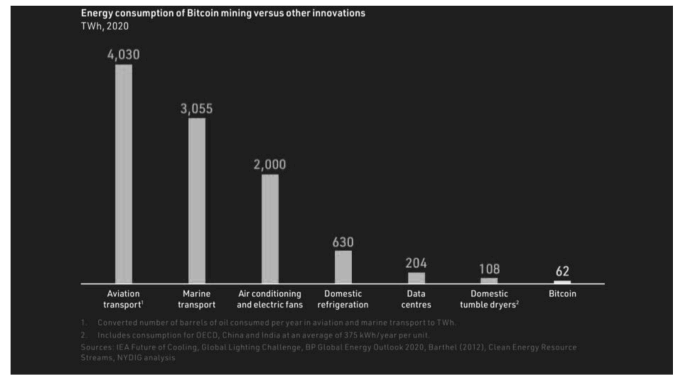
If you are reading this on an electronic device, the hysterical humor of this 2017 headline should be self-evident. And yet, forecasts of a crypto fueled energy consumption apocalypse persist. A full discussion of PoW’s energy consumption must go beyond this paper. We have made several mentions of the subject already, so we will keep this very brief and urge you to read further on the topic.
As noted earlier, much of the derision pointed at PoW’s energy consumption proceeds from a viewpoint that any energy consumed is wasted. This viewpoint ignores crypto’s value as a hedge against fiat debasement, a source of immense future industry and commerce, and an economic lifeline to those without access to legacy financial services (especially in emerging global markets). Consider the positive impact crypto made for Ukraine and Ukrainian refugees this year and how much energy that might be worth to them.
The World Economic Forum is typically a very pro-fiat organization, but even this group has posted a balanced, cogent counterargument against several anti-PoW energy narratives. For perspective, the article includes this graphic:
In May 2022, a group of prominent crypto advocates sent a letter to the EPA rebutting another letter sent to the EPA by 23 members of Congress. We would strongly urge you to read these two documents for a better understanding of the energy-related context around PoW and insight into how popular narratives and real-world implementation can be completely misaligned
Should Companies Hold Crypto?
The first signer on that rebuttal letter was Michael Saylor, chief executive officer (CEO) of business intelligence software firm MicroStrategy. As described in numerous online interviews (this one is particularly informative), Saylor found himself running a public company in 2020, freshly mired in the COVID-19-driven economic downturn, wondering what to do with his firm’s treasury holdings. Faced with rising inflation and negative real yields everywhere he looked, Saylor’s due diligence led him to one inevitable choice: either fold up the company and return funds to shareholders or convert a significant part of MicroStrategy’s holdings to Bitcoins. He took the latter route. In doing so, he was very transparent with his operations and methods. Ultimately, MicroStrategy became a blueprint for how other companies could hold Bitcoin.
Today, roughly 40 public companies now hold Bitcoin in their treasuries. Most view these holdings as long-term investments and hedges and have held on to their Bitcoin throughout the 2022 downturn. There are some notable exceptions.
For institutions that want more of an escorted approach to crypto, services firms like NYDIG now exist. NYDIG incorporated in 2017 and maintains a leadership team spawned from legacy finance. The company seeks to bridge the legacy, “tradfi” and crypto worlds through various means. For example, NYDIG guided the Massachusetts Mutual Life Insurance Company (MassMutual) into a $100 million Bitcoin acquisition in late 2020 and the New York Life Insurance Company into a $50 million crypto purchase via the NYDIG Digital Asset Fund in 2021. NYDIG helps clients procure, custody, and hedge their bitcoin allocations.
One might assume that companies that get comfortable holding crypto will be more open to offering digital assets as employee compensation.
Note that the caveats discussed earlier should apply here. Cryptoassets remain volatile, as 2022 continues to prove. Tesla stated that it sold a large part of its Bitcoin holdings earlier this year to raise cash in advance of expected economic and supply chain turbulence. Whether a corporate crypto allocation makes sense, and the relative size of that allocation, will depend on a host of dynamic factors.
Compensating Workers With Crypto
With a Third-Party Service
A company can compensate workers with cryptocurrency while not holding any in their own treasury. Through a slightly indirect fashion, NYDIG does this for its own employees. Company payroll compensates workers in U.S. dollars (USD). However, as with other payroll benefits, some or even all of that compensation can flow back to NYDIG. NYDIG will then use that money to buy Bitcoin (BTC) on the worker’s behalf. That BTC then deposits into the worker’s NYDIG account, with NYDIG custodying the coins. (You can take control (custody) of coins yourself or entrust them to a third party. Bank safe deposit boxes perform a similar function for physical assets. Each custody option comes with its own risks and responsibilities.) In this way, the worker’s BTC holdings accumulate over time, dollar-cost averaging with each paycheck, and there is no worry over self-custodying responsibilities.
Functionally, this arrangement is no different from having, for example, 90% of a check direct-deposit into a conventional bank checking account while 10% goes to a higher yield savings fund at another bank. One of NYDIG’s many services is to help companies offer this post-tax payroll benefit to their workers. Companies like Bitwage and Bitpay (founded in 2011) have been doing this for several years. Newer entrants, including Coinbase and Strike, offer similar services. To be clear, we at Thrive HR recommend that companies run payroll, pay all required taxes, and deduct all required taxes from employee pay, and then allocate the worker’s desired amount or percentage of pay out for conversion to crypto. Service partners should emphasize this order of operations.
Regardless of the provider, this compensation model offers zero risk to employers because they have no exposure to fluctuating cryptocurrency values. They simply trade USD for BTC (in this case), then immediately transfer ownership of that BTC into the worker’s account. NYDIG charges no transaction fees to workers because the employer pays for them to have access to these services.
“When a company wants to make bitcoin compensation easy for employees, that’s where we excel,” says NYDIG’s Sells, “Employers don’t have to deal with all the heavy lifting of figuring out how to set up transactions, custodying, and everything else. It’s a couple of minutes for the worker, and they perceive the company is doing the work for them. It removes a lot of the friction and difficulty around access.”
Naturally, service providers have to make their money somehow. Some services charge no fees (such as Strike and Coinbase Direct Deposit), but they still make money on the spread (the difference between bid and ask prices). Some, like PayPal, charge a fee plus the spread. Spread amounts can vary by the crypto exchange used and that exchange’s amount of liquidity.
“We use an independent reference rate,” explains Sells, “the Chicago Mercantile Exchange reference rate, which is the average price of the four U.S. platforms with the most liquidity flow. And we use a set time—4:00 PM London standard time. That way, we’re always using an independent reference rate to make that conversion and protect users on their USD/BTC conversions.”
Having a third-party compensation service offloads the need for companies to achieve a deeper technical understanding of crypto. It lifts away the responsibility of understanding the differences between PoW and PoS, which blockchains excel at which corners of the trilemma, which coins are more subject to volatility and risk, and all the rest. However an employer wades into crypto, due diligence is required, but outsourcing the service means there is only a single point of due diligence burden: the service provider.
Regulations
When dealing with financial services, state and federal regulations often come into play. The most notable of these are the “know your customer” (KYC) and “anti-money laundering” (AML) laws, which traditionally have been the purview of financial institutions but are increasingly being adopted in broader circles. The point of both efforts is to prevent money laundering, but remaining compliant can entail navigating significant amounts of legal ambiguity and reporting.
The red tape can get worse when compensating overseas workers. Companies may have to contend with factors such as sanctions and Office of Foreign Assets Control (OFAC) regulations. (International restrictions are currently so convoluted that NYDIG restricts its Bitcoin Savings Plan service to U.S.-based employees.) In time, such conditions will likely ease, but today they remain a serious headwind for crypto compensation
Taxes
Today, debate swirls around the nature of cryptocurrencies. Are they commodities or securities? FindLaw offers an excellent summary of the difference between the two types, and it supports the current, very general agreement: Bitcoin is a commodity, nearly every other crypto is a security, and Ethereum is anybody’s guess at the moment. As noted by The Tax Advisor, “The gains or losses from trading in securities and commodities are considered capital unless the trader makes a mark-to-market election under Sec. 475, which treats the gains and losses as ordinary income.” Thus, crypto holders can bypass most commodity versus security worries and instead focus on how crypto is treated as taxable capital.
The Internal Revenue Service (IRS) offers the definitive stance on capital taxation. Owners need to worry about whether an asset is held for the short term (under one year, in which case gains from the sale of the asset are treated as regular income) or the long term. Gains and losses are reported on Schedule D and Form 8949. Most people will face a capital gains tax rate of 15% or 20%, although the IRS notes that “net capital gains from selling collectibles (such as coins or art) are taxed at a maximum 28% rate.” File that tidbit for future reference if you dabble in social tokens or NFT artwork.
One advantage of outsourcing crypto compensation is that the employer can sidestep all crypto-related tax worries, as the company never obtains or sells any assets. How the worker deals with those issues is the worker’s concern, although it would be a kind gesture for the employer to direct employees to information about tax considerations to avoid unpleasant surprises. Intuit offers one user-friendly overview under “How is crypto taxed?”
The Prospect of Direct Compensation
As should now be clear, there are pros and cons for companies directly holding crypto. One of the cons, especially for smaller companies, could be complexity of accounting for sales as part of paying employees in crypto. Simply consider the prospect of buying $10,000 of Bitcoin on January 1 and then paying different employees $500 of that Bitcoin at different times. Depending on price fluctuations, 10 of those payments might incur a gain and the other 10 a loss. If it takes more than 12 months to spend through that initial coin purchase, some transactions may be short-term and others long-term.
As should now be clear, there are pros and cons for companies directly holding crypto. One of the cons, especially for smaller companies, could be complexity of accounting for sales as part of paying employees in crypto. Simply consider the prospect of buying $10,000 of Bitcoin on January 1 and then paying different employees $500 of that Bitcoin at different times. Depending on price fluctuations, 10 of those payments might incur a gain and the other 10 a loss. If it takes more than 12 months to spend through that initial coin purchase, some transactions may be short-term and others long-term.
“Different accountants treat crypto in different ways,” says Vanina Ivanova, chief marketing officer for Ambire, a blockchain solutions company based in Bulgaria. “One would say that you should put crypto on your tax return as financial instrument, investment, or whatever, and pay, for example, 15% dividend tax. The other one will tell you, oh no, just put it as income tax. It’s a giant, giant mess. And if you refer to the country’s taxation authorities, they would not have a clue.
Again, when a third-party crypto compensation service is used, these worries do not affect the employer. On the other hand, the employer also will not have that asset on its balance sheet if it appreciates in value.
Note that non-U.S. regions may have different laws. Bitcoin is legal tender in El Salvador, for instance, so there are no taxable events incurred when selling Bitcoin in that country and far fewer worries for companies holding it there. Portugal treats crypto as currency, so no gains or value added taxes (VATs) apply there. Other countries, especially emerging countries struggling against high inflation and international debt, seem likely to follow suit if and when the crypto market resumes its upward trend.
Interestingly, Ambire does hold multiple cryptocurrencies in its treasury, but the company still does not pay employees directly . . . usually.
“We have discussed compensating employees in crypto at Ambire,” says Ivanova, “and I’ll be completely honest with you. We do not do that because of legislation and jurisdiction. Our company is registered in Estonia in Europe, and then the core team of the company is in Bulgaria in Eastern Europe. The law says employees must be paid in the country’s official currency, which means that if you would like to pay an employee in crypto in Bulgaria, that’s practically illegal. There’s a loophole, though. You have to provide the base compensation in Bulgarian leva, but if you would like to pay bonuses over time, meaning anything above the base, then you there’s no law that prohibits you from doing that in crypto.”
In short, crypto compensation may not be allowed, but it is not disallowed. Ivanova adds that Ambire has paid contractors directly in crypto for years, largely because “it’s easier and faster.” Those contractors prefer crypto payments because they hold crypto themselves, just as Ambire does. Whether U.S. employers want to navigate this murky landscape will be a matter of time, conditions, and preferences. Predictably, NYDIG’s Sells advises caution.
“Some companies could say, look, we’re willing to take certain risks here, but then you’re inviting potential lawsuits or issues with the CFTC, for example, because it isn’t abundantly clear how crypto is supposed to work” says Sells. “And if you misstep, then the company has much more legal liability than if the employee simply wants to take some of his or her money and put it into Bitcoin.”
What About Stablecoins?
At this time, we would only recommend asset-backed stablecoins, and we do recommend them for certain use cases. To the uninitiated, stablecoins may seem counterintuitive. After all, if each coin is worth $1, why not just use dollars?
To begin with, one answer is in the name. Stablecoins are cryptocurrencies, but their value is quite stable compared to the volatility typical of BTC, ETH, and other coins. As cryptocurrencies, stablecoins mint on blockchains, operate like any other coin on supporting crypto exchanges, and are easy to store in hot or cold wallets. Because stablecoins are cryptoassets, there is less friction when converting them into other cryptocurrencies, such as BTC or ETH, because they operate on the same “rails.” Converting dollars requires more steps and can incur lengthy settlement delays. Stablecoins may be better for those who value more options and self management over their money. Also, in many geographies, people want access to dollars but have no means of getting USD without resorting to the black market. Stablecoins offer a worldwide alternative to USD that remains pegged to USD value but does not require an account with or permission from traditional financial system gatekeepers.
“If I had the choice between getting paid in fiat, a stablecoin, or Bitcoin, I would probably choose a mix of fiat and stablecoin,” says Ambire’s Ivanova. “It just makes things easier when it comes to reporting and paying taxes. Obviously, Bitcoin is a store of value for me personally, but I’m not sure I’d be willing to take the risk of getting paid in Bitcoin when it’s so volatile.”
Five Critical, Actionable Tips for Businesses
We have covered a remarkable swath of information in this paper, yet we feel we have hardly scratched the subject’s surface. In particular, we have given short shrift to PoS options, such as Ethereum and Solana. There are fascinating projects like the Chainlink blockchain and its LINK token, which may revolutionize data and asset tracking, or the Cosmos (ATOM) ecosystem, which aims to serve as the network that unites the world’s blockchains. For now, in this paper’s context, a first dive into Bitcoin and its ramifications in employee compensation, will have to do.
In wading through all the information we have covered here, it may be easy to feel overwhelmed. Everybody starts at that point. So, if you get nothing else from this paper, we strongly encourage you to follow these five advice points.
Conclusion: Gradually, Then Suddenly
Regulation and clarity around crypto is coming, as is a more accommodating macroeconomic environment. Understanding about crypto across individuals, businesses, and governments is better now than in 2020, and it will be much better in 2024 than today. Nearly all signs point toward global crypto adoption as one of how, not if.
NYDIG’s Sells observes, “Of the private companies I’ve talked to over the last couple years that already own Bitcoin allocations in their corporate treasury, the variety of industries they were in blew my mind. A lot of that, I think, is tied to the business owner and their own understanding of Bitcoin and crypto.”
Diversity is prudent for companies and employees alike. Younger workers in particular get this, and those workers will influence and found their own companies as the years go on. Well beyond factors such as social background, education, gender, and so on, diversity can and should also encompass economic beliefs and mindsets. This paper aims to play some tiny role in encouraging that diversity and help pave the way for when crypto regulations are more defined and companies can more easily leverage crypto’s many advantages, only a few of which are discussed above. Most of those future advantages have not even been invented yet.
For now, we are at first steps, and services such as NYDIG’s can help employers take those early strides with confidence, particularly since there is no risk and participation is entirely elective, as with any other payroll deduction benefit.
“Not every employee signs up,” says Sells. “You’re not forcing it on them. It can be very much an optional benefit. But by offering crypto benefits, you can harness the momentum in the broader economy and consumer interest without alienating or causing issues with employees who aren’t interested yet.”
Companies that integrate crypto compensation now will be in the vanguard of the coming adoption wave. As Forbes noted this summer, “global Bitcoin adoption will break past 10% in the year 2030. After that, growth could become parabolic, eventually reaching 80% of the population in the 2050s.” Other sources may offer different adoption rates and models, but the overall idea remains consistent.
NYDIG’s Sells adds, “Over a hundred banks have a Bitcoin product of some sort. I think that will be a couple hundred by the end of the year. That’s slow moving in one sense, but it’s actually ripping through the banking industry as fast as any innovation ever has.”
These days, in our current business and economic climate, every company and HR executive understands the war for talent. Anything you can do to obtain an edge with talent today is crucial. Adopting crypto compensation options may give you that edge with forward-looking employees, allowing you to recruit and retain more effectively than your peers. This paper has shown that technical knowledge should no longer be a barrier, only a bonus.
For more information on how crypto compensation can benefit your organization and human resources programs, contact Thrive HR at (817) 308- 8959 or www.thrivehrconsultin.com